The conversion in two steps
Pitch (mm) = 25.4 ÷ mesh countNominal opening (mm) = pitch − wire diameter (mm)Nominal opening (µm) = opening (mm) × 1,000The 25.4 constant is exact because one international inch equals 25.4 mm. The result describes the ideal nominal geometry. Manufacturing tolerances and the agreed inspection method decide whether delivered cloth conforms.
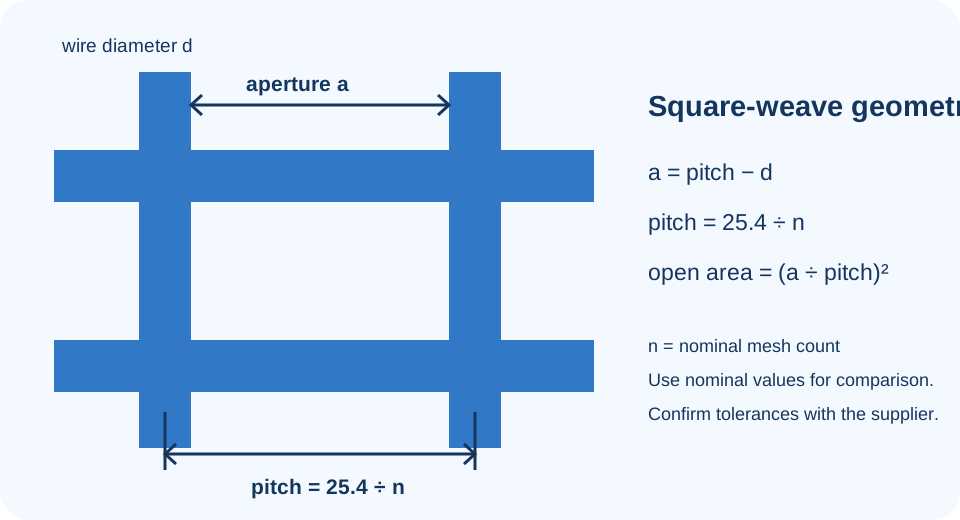
Input check before calculating
You have mesh count + wire diameter
You can calculate nominal pitch, opening and square-mesh open area. Use the spec converter for the calculation.
You only have “100 mesh”
You cannot derive one unique opening. Ask for wire diameter, or for the supplier's aperture-and-wire combination. Do not silently choose a “typical” wire.
Worked examples
These are arithmetic examples, not a standard-size table. Each row states the wire diameter used, so the result can be reproduced.
| Given specification | Pitch | Nominal opening | Square open area |
|---|---|---|---|
| 20 mesh × 0.50 mm wire | 1.270 mm | 0.770 mm / 770 µm | 36.8% |
| 60 mesh × 0.18 mm wire | 0.423 mm | 0.243 mm / 243 µm | 33.0% |
| 100 mesh × 0.10 mm wire | 0.254 mm | 0.154 mm / 154 µm | 36.8% |
Open area for an ideal square weave = (opening ÷ pitch)² × 100. Values above are rounded.
Where this formula applies—and where it does not
| Product description | Use this formula? | What to confirm |
|---|---|---|
| Square-aperture woven wire cloth | Yes, as a nominal geometry check | Mesh count, wire diameter, agreed tolerance and test method |
| Dutch or filter cloth | No simple square-opening conversion | Retention or pore-related specification and the applicable filter-cloth standard |
| Welded mesh | Do not assume woven-cloth mesh-count convention | Clear opening or centre spacing, wire diameter, panel/roll dimensions |
| Cloth coated after weaving | Use caution | Whether opening and wire diameter are before or after coating |
Turn the result into a usable specification
- State mesh count and the count unit or method.
- State wire diameter in mm or inches—avoid an unlabeled gauge number.
- Record the calculated nominal opening and whether it is a target or a measured value.
- Add material, weave, dimensions, edge condition, quantity and applicable tolerance/inspection basis.
Calculate with your actual wire diameter
The converter keeps this article focused on method while giving you a reproducible result and a copyable specification line.
Primary references
- NIST: SI Units—Length — exact inch-to-millimetre definition.
- ISO 9044:2016 — terms, tolerances, requirements and test methods for square-aperture industrial woven wire cloth.
- ISO 4783-2:1989 — preferred aperture-and-wire combinations and designation sequence.
- ASTM E2016 — industrial woven wire cloth scope and technical requirements.