Wire Mesh,
Answered.
Turn mesh count, wire diameter, aperture and material into a specification you can check, save and send to a supplier.
From welded to hexagonal
Spec converter, selector & calculator
All tools & guides free, instant
Formulas · limits · source notes
Browse by Mesh Type
Not sure what type you need? Start here — each category links to full specs, applications, and buying guidance.
Welded Wire Mesh
Electrically welded grid. Rigid, dimensionally precise, for fencing, reinforcement and caging.
Woven Wire Mesh
Interlocked over-under weave. Flexible, precise openings — the backbone of filtration and screening.
Crimped Wire Mesh
Pre-crimped wires lock into position. Heavy-duty — gravel screening, quarry decks, vibrating screens.
Expanded Metal
Slit-and-stretched sheet. No welds, no waste. Walkways, ventilation, architectural facades.
Gabion Mesh
Double-twist hexagonal wire cages filled with rock. Retaining walls, erosion control, landscaping.
Hexagonal / Chicken Wire
Lightweight hex pattern. Poultry fencing, garden borders, craft backing and plaster lath.
Security Fencing
358 anti-climb, palisade and welded panels. High-security perimeters and access control.
Filter / Screen Mesh
Fine-woven stainless or brass mesh for liquid, gas and particle filtration across industries.
Browse by Application
Know the job, not the product? Find the right mesh for your specific application.
The Tools That Answer the Hard Questions
Instant, free, browser-based — convert units, match mesh to your application, or calculate weight and roll length in seconds.
Mesh Spec Converter
Instantly convert between mesh count, opening size, wire gauge and open area %. Stop guessing — verify specs from any datasheet.
Mesh Selector
Tell us your application and material requirements. The selector recommends the right mesh type, spec range and key considerations.
Weight & Roll Calculator
Enter mesh count, wire diameter, density and roll size — get a nominal cloth-weight estimate you can save and check.
Free · No sign-up · Instant · Works in any browser
Questions Buyers Actually Ask
Real questions from engineers, procurement teams and importers — answered in plain English, with verifiable specs.
Welded vs woven mesh — what's the difference?
Welded mesh is electrically fused at intersections for rigidity and precise square openings. Woven mesh interlocks individual wires for flexibility and fine filtration. The right choice depends on your application load and opening tolerance.
Read full answerHow do I read mesh specifications (count, opening, gauge)?
Mesh count = wires per inch. Opening size = the clear gap between wires. Wire gauge = wire diameter (BWG or mm). These three numbers define any mesh — the Spec Converter translates between them instantly.
Read full answerWhich mesh should I use for fencing vs filtration?
Fencing needs structural strength and corrosion resistance — galvanised or PVC-coated welded mesh is the standard. Filtration demands precise opening control — woven stainless is preferred for food, pharma and process industries.
Read full answerHow much does wire mesh cost? (indicative ranges)
Price varies widely by material, wire diameter, mesh count and order volume. Galvanised welded mesh for construction is generally the most affordable; fine stainless filter mesh costs significantly more. Use our Weight Calculator for indicative cost-per-kg estimates.
Read full answerGalvanised vs stainless steel mesh — when does it matter?
Galvanised (zinc-coated) is cost-effective for outdoor construction in moderate climates. Stainless (304 or 316) is essential for corrosive environments, food contact, and long service life outdoors near saltwater.
Read full answerHow do I convert mesh count to opening size in mm?
Opening (mm) = (25.4 / mesh count) − wire diameter (mm). For a 10-mesh wire with 0.9 mm wire: opening = 2.54 − 0.9 = 1.64 mm. Our Spec Converter handles this calculation for any combination of values.
Read full answer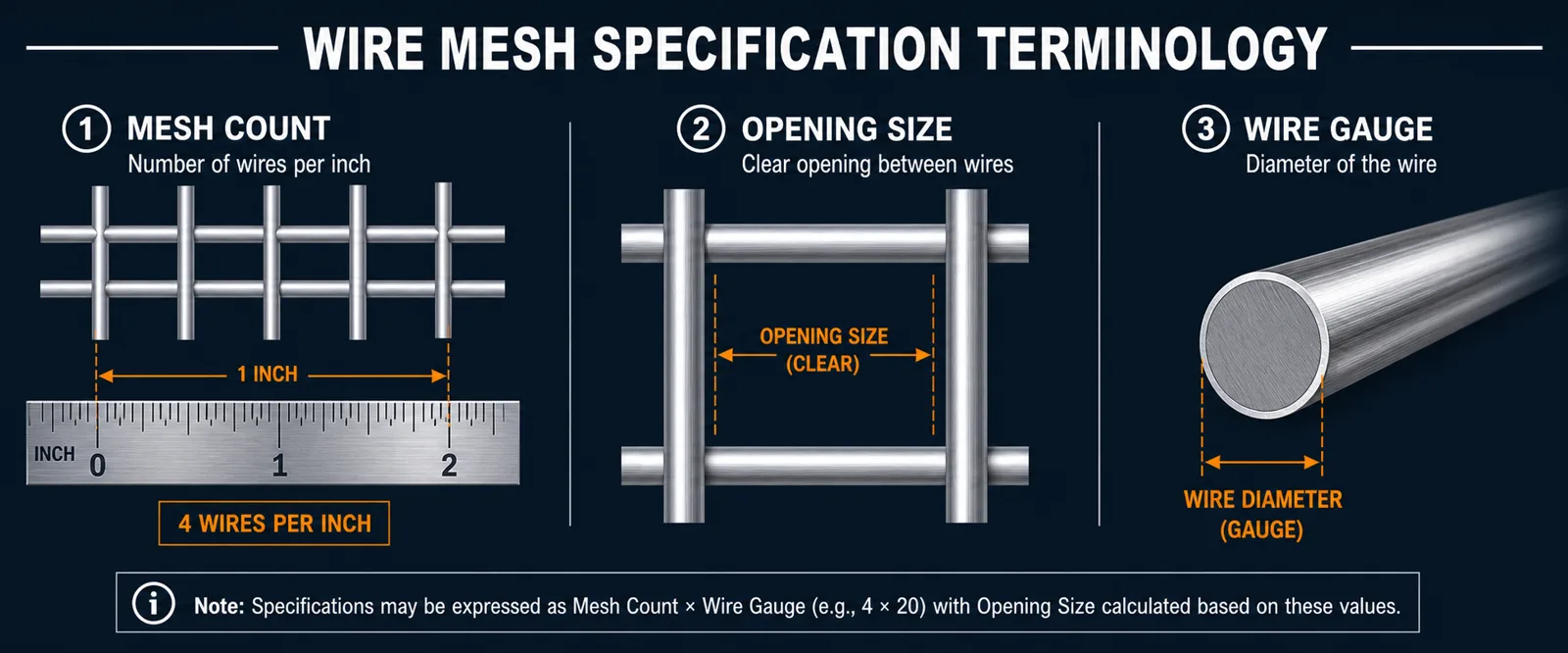
Three Numbers That Define Every Mesh
Mesh Count
The number of wires (or openings) per linear inch. Higher count = finer openings. Used in US/UK standards; metric equivalents exist.
Opening Size
The nominal clear distance between adjacent wires, in mm or inches. Particle separation still depends on tolerance, weave and operating conditions.
Wire Gauge / Diameter
The diameter of each wire, in mm or BWG gauge number. Thicker wire = stronger mesh but smaller opening at the same mesh count.
Side-by-Side Comparisons
The most-asked "which is better" questions — answered with a structured comparison of specs, cost, and applications.
Check the Method, Not a Marketing Claim
Ownership Disclosed
WireMeshQA and FenceAndMesh are operated by the same team. Technical guidance stays here; product and quotation enquiries continue there.
Explained in Plain English
We translate industry jargon into language that engineers, procurement teams and first-time buyers can all act on. Complex specs, made simple.
Sources Where They Matter
Calculation pages show the equation, scope, limits and relevant standards. Approximate values are labelled rather than presented as certificates.
Supplier Confirmation Required
Tools create a nominal planning baseline. Critical tolerances, material certificates, packed weight and performance must be confirmed with the supplier.
Need to Build a Mesh Specification?
Start with the application, opening, wire diameter and material. The mesh selector turns those inputs into a clearer specification brief.
Open the Mesh Selector