Wire Mesh Weight Calculator
Estimate weight per square metre and roll weight from mesh count, wire diameter and material — for freight, quotes and load planning.
Your mesh
Results
The formula (transparent)
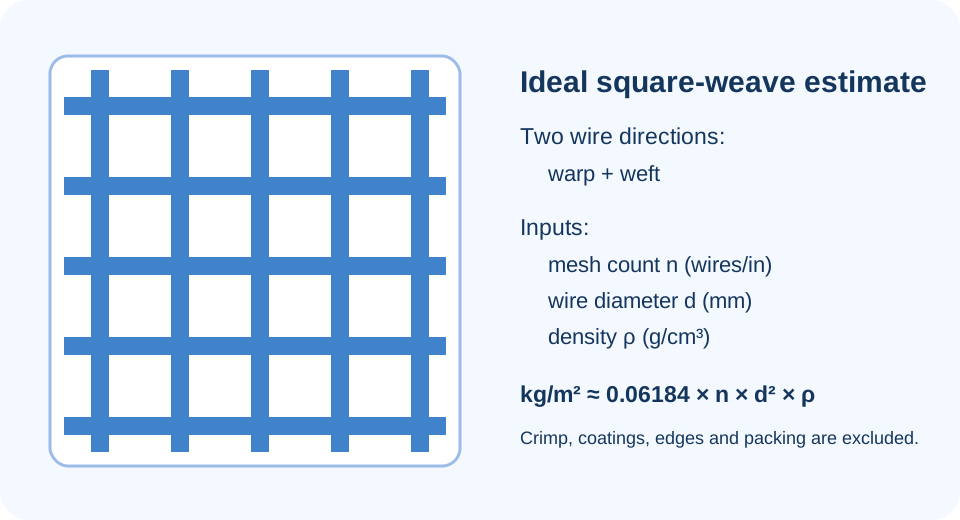
weight (kg/m²) ≈ 0.06184 × mesh count × wire diameter² (mm) × density (g/cm³)
roll weight = weight/m² × width (m) × length (m). The constant follows from two perpendicular sets of one-metre-long cylindrical wires and the exact conversion 1 inch = 25.4 mm.
FAQ
How do you calculate wire mesh weight per square metre?
For square woven mesh, weight (kg/m²) ≈ 0.06184 × mesh count × wire diameter² × material density, where mesh count is wires per inch, wire diameter is in mm and density is in g/cm³. This sums the warp and weft wire mass in one square metre; it does not include crimp, manufacturing tolerances, coating, selvage or packaging.
Does material affect wire mesh weight?
Yes. Weight scales directly with density: stainless 316 (7.98) and 304 (7.93) are close to carbon/galvanised steel (7.85), while aluminium (2.70) is about a third of the weight and brass/copper are heavier. Select a preset or enter the density from your material documentation.
What is roll weight?
Roll weight = weight per m² × roll width (m) × roll length (m). Enter the roll dimensions to estimate nominal cloth weight for freight planning, then confirm the actual packed weight.
What this calculator does — and why mesh weight matters
Wire mesh is bought, shipped and freighted by weight, not by the metre. A roll that looks identical on a spec sheet can weigh very different amounts once you change the material, the wire diameter or the mesh count — and getting that figure wrong throws off your budgeting, your freight quotes and your container loading. Using the default density presets, the same 10-mesh cloth in stainless weighs about 2.9 times as much as the aluminium version, so a guess based on "area" alone is rarely safe.
This free calculator gives you an instant, transparent estimate of areal weight (kg/m²) and full roll weight from three inputs: mesh count, wire diameter and material. It uses the shown ideal square-woven formula and editable density inputs, so the result is reproducible and easy to check by hand. Use it to sanity-check a supplier quote, plan a shipment, or compare two material options before you commit. For converting between mesh, microns and inches first, see the spec converter; to narrow down a mesh by application, try the mesh selector.
Worked examples
Example 1 — 10 mesh, 0.9 mm wire, mild steel
Start with the formula: weight (kg/m²) = 0.06184 × mesh count × wire diameter² × density. Plug in 10 mesh, 0.9 mm wire and a mild/galvanised steel density of 7.85 g/cm³: 0.06184 × 10 × (0.9 × 0.9) × 7.85 = 0.06184 × 10 × 0.81 × 7.85. That works out to 3.93 kg/m². So a single square metre of this cloth weighs just under four kilograms.
Example 2 — the SAME mesh in aluminium
Keep everything identical — 10 mesh, 0.9 mm wire — but switch the material to aluminium (density 2.70 g/cm³): 0.06184 × 10 × 0.81 × 2.70 = 1.35 kg/m². Same opening, same wire, yet the cloth now weighs about a third of the steel version. Material choice — not the weave — is the single biggest lever on shipped weight, which is why it pays to compare options before ordering. The relationship is exactly the density ratio: 2.70 / 7.85 = 0.34, and 3.93 × 0.34 = 1.35.
Example 3 — full roll weight, 30 mesh, 0.30 mm wire, stainless 304
First the areal weight: 0.06184 × 30 × (0.30 × 0.30) × 7.93 = 0.06184 × 30 × 0.09 × 7.93 = 1.32 kg/m² (1.324 before rounding). Now scale to a roll measuring 1.2 m wide × 30 m long = 36 m² of cloth. Multiply: 1.324 × 36 = 47.7 kg per roll. That is the indicative cloth weight you would use for freight planning — actual packed weight will be slightly higher once core, packaging and any selvage are included.
Wire mesh material density reference
Areal weight scales directly with material density, so the density figure you feed the formula matters more than any other single input. The table below lists the densities used by this calculator, each shown relative to mild steel (density ÷ 7.85) so you can see at a glance how much lighter or heavier a given material will make the same cloth. These are editable reference presets for common materials used in woven wire mesh.
| Material | Density (g/cm³) | Relative weight vs steel | Typical use |
|---|---|---|---|
| Mild / galvanised steel | 7.85 | 1.00× | General-purpose screening, fencing, aggregate and construction mesh; galvanising adds corrosion resistance at low cost. |
| Stainless steel 304 | 7.93 | 1.01× | Filtration, food processing and architecture where good corrosion resistance and hygiene are needed. |
| Stainless steel 316 | 7.98 | 1.02× | Marine, chemical and high-chloride environments needing extra corrosion and pitting resistance. See ss304 vs ss316. |
| Aluminium | 2.70 | 0.34× | Lightweight insect screens, ventilation and architectural panels where weight and easy handling matter. |
| Brass | 8.50 | 1.08× | Decorative screens, fine filtration and acoustic mesh; non-sparking and corrosion-resistant in many media. |
| Copper | 8.96 | 1.14× | EMI/RF shielding, decorative and antimicrobial applications; the heaviest of the common mesh materials. |
Densities are editable reference presets for planning. Real coil weight can differ slightly from a density-based estimate because of wire tolerance, coating (e.g. galvanising or PVC), selvage and edge treatment. To compare the two grades in detail, see ss304 vs ss316.
Who uses this calculator — industries and roles
Anyone who plans, prices or ships woven wire mesh runs into the weight question. Importers and distributors use it to estimate freight and check whether a quoted roll weight looks right; procurement and estimators use it to build accurate material budgets; logistics and shipping teams use it for container loading and pallet planning. On the technical side, design engineers and specifiers use areal weight to compare material options and confirm a structure can carry the load. The same calculation matters across filtration, mining and aggregates, food processing, chemical processing, water treatment, architecture, agriculture and general construction — wherever mesh is bought by weight and shipped in volume. For a fuller breakdown of what drives total landed cost, see the wire mesh cost guide.
Why you can trust this calculator
WireMeshQA publishes the method, inputs and limits so the estimate can be checked instead of taken on trust. WireMeshQA is operated by the same team as FenceAndMesh; commercial product and quotation enquiries are handled there. The formula and densities are shown openly so you can reproduce every result by hand, and every figure is clearly labelled as an indicative estimate.
- The full formula is shown on the page — nothing is hidden, and you can check any result with a calculator.
- Material densities are editable reference presets; use a certified value when one is available.
- Results are indicative estimates of cloth weight, not guaranteed packed or invoiced weights.
- Real coil weight varies with wire tolerance, coating, selvage, edge treatment and packing, so we tell you that rather than imply false precision.
- The calculation is separated from commercial sourcing, and the shared operation with FenceAndMesh is disclosed.
Method and source notes
The mass equation is a first-principles estimate for straight, circular wires in two perpendicular directions. The standards below define the relevant square-woven cloth scope and the unit conversion; they do not certify this calculator or any result.
- NIST: SI Units — Length — the inch is exactly 25.4 mm.
- ISO 9044:2016 — terms, requirements and tests for industrial woven wire cloth with square apertures; excludes welded, pre-crimped and coated-after-weaving screens.
- ASTM E2016 — industrial woven wire cloth scope and tolerances; excludes welded cloth and Dutch weave/filter cloth.
- British Stainless Steel Association — room-temperature density context for common stainless grades.
Reviewed 9 September 2026. Results are nominal planning estimates; no standards-conformance claim is made.
Key terms, defined
- Areal weight (kg/m²)
- The weight of one square metre of the woven cloth. It is the core output of this calculator and the figure you scale up to get roll or shipment weight.
- Wire diameter
- The thickness of the individual wire used to weave the mesh, measured in millimetres. Because it is squared in the formula, small changes in diameter have a large effect on weight.
- Density
- The mass per unit volume of the mesh material, in grams per cubic centimetre. It is set by the alloy you choose and scales weight directly — heavier material, heavier cloth.
- Roll / coil weight
- The total weight of a full roll, found by multiplying areal weight by the roll area (width × length). It is the figure used for freight, pallet and container planning.
Frequently asked questions
How do you calculate wire mesh weight per square metre?
For square woven mesh, weight (kg/m²) ≈ 0.06184 × mesh count × wire diameter² × material density, where mesh count is wires per inch, wire diameter is in mm and density is in g/cm³. This sums the warp and weft wire mass in one square metre; it does not include crimp, manufacturing tolerances, coating, selvage or packaging.
Does material affect wire mesh weight?
Yes. Weight scales directly with density: stainless 316 (7.98) and 304 (7.93) are close to carbon/galvanised steel (7.85), while aluminium (2.70) is about a third of the weight and brass/copper are heavier. Select a preset or enter the density from your material documentation.
What is roll weight?
Roll weight = weight per m² × roll width (m) × roll length (m). Enter the roll dimensions to estimate nominal cloth weight for freight planning, then confirm the actual packed weight.
How do I estimate the weight of a full roll?
First find the areal weight in kg/m² using mesh count, wire diameter and material density. Then multiply by the roll area in square metres, which is width × length. For example, a cloth at 1.32 kg/m² on a 1.2 m × 30 m roll (36 m²) gives about 47.7 kg of nominal cloth before packaging.
Why is stainless mesh heavier than aluminium mesh?
Weight scales directly with material density. Stainless 304 has a density of about 7.93 g/cm³ while aluminium is only 2.70 g/cm³ — roughly a third as dense. So an identical mesh count and wire diameter in stainless weighs nearly three times as much as the same cloth in aluminium.
Does the calculator include the edge or selvage weight?
No. The result is the indicative weight of the plain woven cloth based on mesh count, wire diameter and density. It does not add core, packaging, coating, or any reinforced edge or selvage. Treat the figure as an estimate for planning and obtain the packed weight from the supplier.
Need to document the estimate?
Download the calculation record, add tolerances and packing assumptions, then compare it with the supplier data.
Review the Specification Guide → Continue to a product enquiry →