Wire Mesh Spec Converter
Calculate nominal opening size (inch / mm / micron), open area % and pitch from mesh count and wire diameter — with the formulas and scope shown.
Your mesh
Results
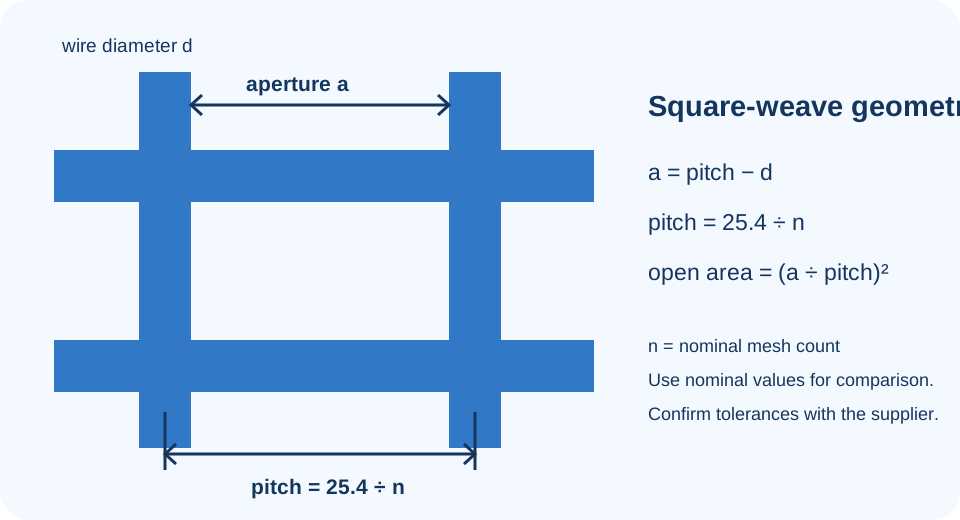
The formulas (transparent — no black box)
| Spec | Formula |
|---|---|
| Pitch (centre-to-centre) | pitch = 25.4 / mesh count (mm) · 1 / mesh count (inch) |
| Opening (clear gap) | opening = pitch − wire diameter |
| Opening in microns | micron = opening(mm) × 1000 |
| Open area % | (opening / pitch)² × 100 |
Note: mesh count is wires per inch (so higher count = smaller opening at the same wire). Open area drives flow/filtration; pitch = opening + wire diameter.
What this converter does — and the problem it solves
Wire mesh is described in a frustrating mix of units. One spec sheet lists a mesh count (wires per inch), another lists an opening in millimetres, a filtration datasheet quotes a micron rating, and an imperial drawing calls out fractions of an inch — all while the same screen also has an open area percentage and a wire diameter that change every one of those figures. Buyers, engineers and QC staff constantly have to translate between them, and a single mistaken conversion means ordering the wrong screen, the wrong aperture, or a mesh that simply will not pass the particle you need to separate.
This free converter removes the guesswork. Enter a mesh count and wire diameter and it instantly returns the opening in inch, millimetre and micron, the pitch, and the open area — every unit at once, with no sign-up. The math is not hidden in a black box: the exact formulas are printed on this page, so you can reproduce any result by hand and check it against your own mesh spec sheet.
The calculation uses a nominal square-weave geometry: pitch = 25.4 ÷ mesh count, then aperture = pitch − wire diameter. ISO and ASTM sources below are used to bound the woven-cloth scope, not to claim certification. Use it to sanity-check a quotation, compare two suppliers on a like-for-like basis, or convert a micron requirement into a mesh you can actually order.
Worked examples
Example 1 — 10 mesh with 0.9 mm wire (coarse screening)
Start with the pitch: 25.4 ÷ 10 = 2.54 mm. Subtract the wire diameter to get the opening: 2.54 − 0.9 = 1.64 mm. Converted to other units, that is 1640 microns and 0.0646 inch (1.64 ÷ 25.4). The open area is (opening ÷ pitch)² × 100 = (1.64 ÷ 2.54)² × 100 = 41.7%. This gives a nominal 1.64 mm clear aperture and 41.7% geometric open area. Actual separation performance depends on particle shape, loading, tolerances and operating conditions.
Example 2 — 40 mesh with 0.25 mm wire (fine particle separation)
Pitch = 25.4 ÷ 40 = 0.635 mm. Opening = 0.635 − 0.25 = 0.385 mm, which equals 385 microns and 0.0152 inch. Open area = (0.385 ÷ 0.635)² × 100 = 36.8%. The nominal geometry is a 385-micron aperture and 36.8% open area. Use those values to compare specifications; do not treat them as a verified filtration rating or strength claim.
Example 3 — 200 mesh with 0.05 mm wire (micron-grade filtration)
Pitch = 25.4 ÷ 200 = 0.127 mm. Opening = 0.127 − 0.05 = 0.077 mm = 77 microns = 0.0030 inch. Open area = (0.077 ÷ 0.127)² × 100 = 36.8%. A 200-mesh cloth with this nominal wire diameter gives a calculated 77-micron clear aperture; that value is not, by itself, a particle cut point or filtration rating. Note how at this fineness the wire diameter dominates: a small change in wire thickness moves both the micron rating and the open area significantly.
Mesh count to opening size — quick reference table
The table below converts the most common market mesh counts to opening size using a typical wire diameter for each. All values are computed with the formulas shown on this page (opening = 25.4 ÷ mesh − wire diameter). Wire diameter varies by weave and grade, so treat these as standard reference figures — for a critical job, confirm the exact wire diameter with your mill and re-run the converter. For a deeper walk-through see mesh count to opening size.
| Mesh count | Typical wire dia (mm) | Opening (mm) | Opening (inch) | Opening (micron) | Open area |
|---|---|---|---|---|---|
| 4 | 1.6 | 4.750 | 0.1870 | 4750 | 56.0% |
| 8 | 0.8 | 2.375 | 0.0935 | 2375 | 56.0% |
| 10 | 0.9 | 1.640 | 0.0646 | 1640 | 41.7% |
| 20 | 0.45 | 0.820 | 0.0323 | 820 | 41.7% |
| 30 | 0.30 | 0.547 | 0.0215 | 547 | 41.7% |
| 40 | 0.25 | 0.385 | 0.0152 | 385 | 36.8% |
| 60 | 0.18 | 0.243 | 0.0096 | 243 | 33.0% |
| 80 | 0.14 | 0.177 | 0.0070 | 178 | 31.3% |
| 100 | 0.10 | 0.154 | 0.0061 | 154 | 36.8% |
| 150 | 0.065 | 0.104 | 0.0041 | 104 | 38.0% |
| 200 | 0.05 | 0.077 | 0.0030 | 77 | 36.8% |
| 325 | 0.035 | 0.043 | 0.0017 | 43 | 30.5% |
Typical wire diameters shown for reference; actual diameter depends on weave type, alloy and mill standard, and will shift the opening and open area. Always verify against a mill certificate for tolerance-critical applications.
Who uses this converter — industries and roles
Mesh-to-opening conversion is a common task wherever a buyer or engineer needs to compare nominal screen geometry. It is used across filtration and separation, mining and aggregate screening, food and beverage processing, chemical and petrochemical plants, water and wastewater treatment, pharmaceutical manufacturing, construction, oil and gas, and architectural mesh projects. The people running these conversions are just as varied: sourcing and procurement managers checking that a quote matches the spec, design and process engineers sizing a screen for a real particle size, lab and QC technicians validating incoming material, and importers and distributors translating a customer's micron requirement into a mesh they can actually order. A shared, transparent reference keeps all of them speaking the same language.
Why you can trust this converter
WireMeshQA publishes the equations, scope and limitations so each result can be checked. It is operated by the same team as FenceAndMesh; product and quotation enquiries are handled there. Trust here comes from transparency, not claims: every formula used by the calculator is printed on the page, every output unit can be cross-checked by hand, and the conventions match how the industry actually defines woven mesh. We also state the limits plainly, because an honest converter is more useful than a falsely precise one.
- No black box. The exact formulas (pitch = 25.4 ÷ mesh, opening = pitch − wire diameter, open area = (opening ÷ pitch)²) are shown so you can reproduce any result.
- Defined scope. The page treats mesh count as a nominal wires-per-inch input for square woven cloth and links to the relevant ISO and ASTM scope pages.
- Every unit, cross-checkable. Inch, millimetre and micron are derived from the same opening, so they always agree with each other.
- Stated limitations. Real wire diameter, weave type (plain, twill, Dutch) and manufacturing tolerance shift the result — for tolerance-critical work, confirm against a mill certificate.
- Commercial separation. The tool remains a transparent calculation; any product or quotation enquiry continues separately to FenceAndMesh with shared ownership disclosed.
Standards and source notes
This converter applies only to nominal square-woven geometry. The linked standards define scope, terminology and tolerances; they do not certify this tool or any supplier specification.
- NIST: SI Units — Length — the inch is exactly 25.4 mm.
- ISO 9044:2016 — industrial woven wire cloth with square apertures; excludes welded, pre-crimped and coated-after-weaving screens.
- ISO 4783-2:1989 — preferred combinations of aperture size and wire diameter.
- ASTM E2016 — general industrial woven wire cloth and tolerance context; excludes welded cloth and Dutch weave/filter cloth.
Reviewed 9 September 2026. Always confirm critical aperture and wire tolerances on the supplier documentation.
Key terms, defined
- Mesh count
- The number of wires (or openings) per linear inch, counted from the centre of one wire to a point one inch away — a higher mesh count means a finer screen.
- Aperture / opening
- The clear gap between two adjacent wires, equal to the pitch minus the wire diameter, and the figure that actually determines what particle size can pass.
- Open area
- The percentage of the total mesh surface that is open holes rather than wire, which governs flow and throughput for a given aperture.
- Pitch
- The centre-to-centre distance between two neighbouring wires, equal to 25.4 mm divided by the mesh count.
- Wire gauge
- A traditional numbering system for wire thickness; for precise work it should be converted to an actual wire diameter in millimetres or inches before calculating the opening.
Frequently asked questions
How do I convert mesh count to opening size?
Opening = pitch − wire diameter, where pitch = 1 ÷ mesh count. In millimetres: opening (mm) = (25.4 ÷ mesh count) − wire diameter (mm). For example, a 10-mesh screen with 0.9 mm wire has an opening of (25.4 ÷ 10) − 0.9 = 1.64 mm.
How do I convert mesh opening to microns?
Multiply the opening in millimetres by 1,000. An opening of 1.64 mm equals 1,640 microns. To go from microns back to mm, divide by 1,000.
What is open area percentage?
Open area is the share of the mesh surface that is actual holes. Open area % = (opening ÷ pitch)² × 100, where pitch = opening + wire diameter. Higher open area means more flow and light pass-through; lower open area means a stronger, finer screen.
Does a higher mesh count mean a smaller opening?
Yes. Mesh count is the number of wires (and openings) per linear inch, so a higher mesh count packs more wires into the same inch and leaves smaller openings — provided the wire diameter is similar. Wire diameter also matters: a thicker wire at the same mesh count gives a smaller opening.
What's the difference between mesh count and micron rating?
Mesh count is the number of wires per inch and says nothing on its own about the hole size. Microns express the calculated clear aperture between wires; they are not automatically a filtration rating. Two cloths with the same mesh count can have different micron ratings because thicker wire leaves a smaller opening, so always convert mesh plus wire diameter to microns before comparing screens.
Does open area affect flow rate?
Yes. Open area is the share of the surface that is actually open holes, so for the same aperture a higher open area passes more liquid or air and clogs more slowly. When comparing two meshes with similar openings, the one with greater open area generally gives higher throughput and lower pressure drop, which matters in filtration and dewatering.
Why does my supplier's opening differ slightly from the calculation?
The formula assumes a single nominal wire diameter and a plain square weave. In practice the actual wire diameter, the weave type (plain, twill or Dutch), and normal manufacturing tolerance all shift the real opening by a small amount. Use the converter to get a reliable baseline, then confirm the exact figure on the mill certificate for critical specifications.
Need to complete the mesh brief?
Copy the nominal geometry, then add material, finish, dimensions, quantity and required tolerances.
Read the Specification Guide → Continue to a product enquiry →